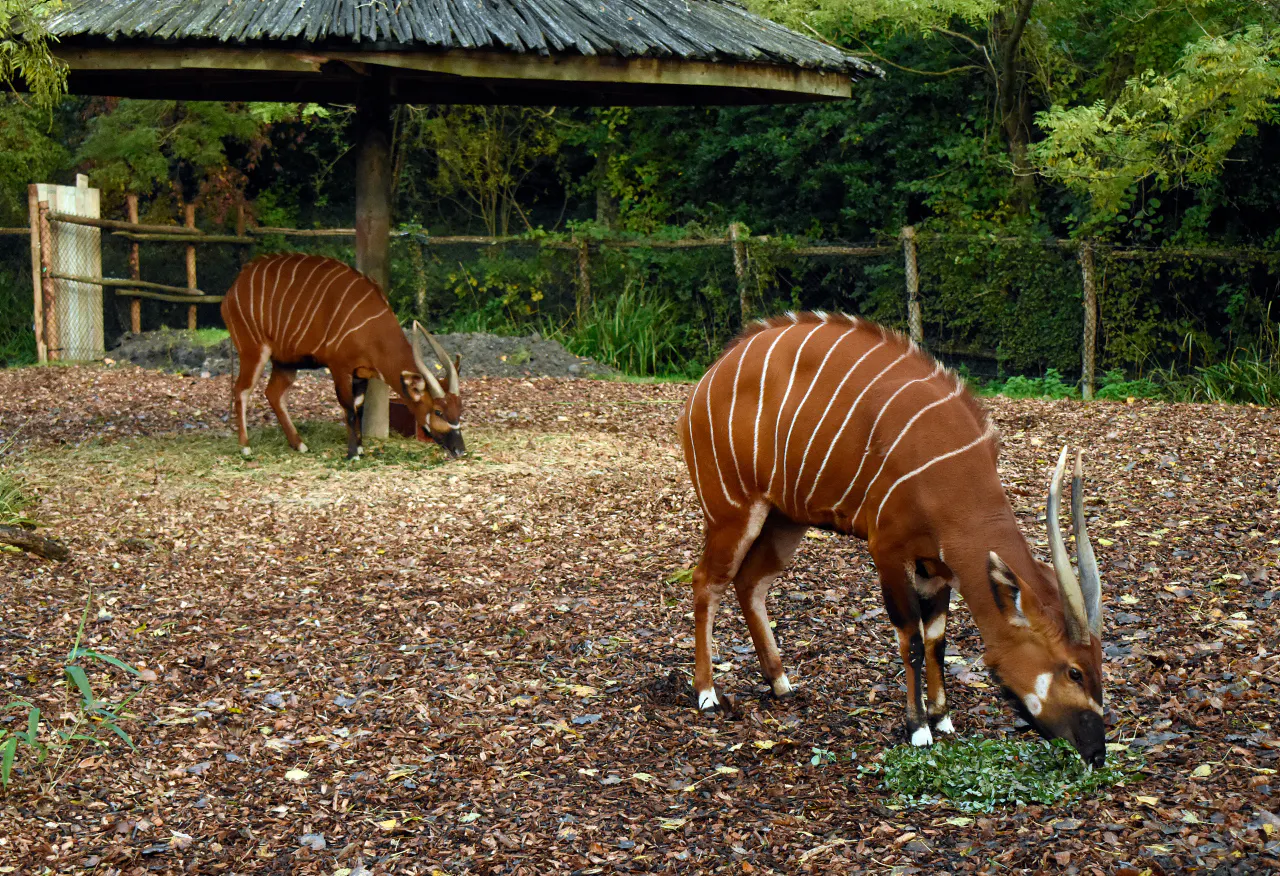
Deep in the African jungle, everything seems quiet. But then, a rustling through the foliage, a flash of red… and it’s gone again. It was a bongo. This reclusive antelope is a rare sight. It only emerges from the forest at night to eat and drink. Read more about this mysterious animal here.
Tragelaphus eurycerus isaaci
Up to 22 years
125 centimetres
230 centimetres
♂ 300 kilograms
♀ 240 kilograms
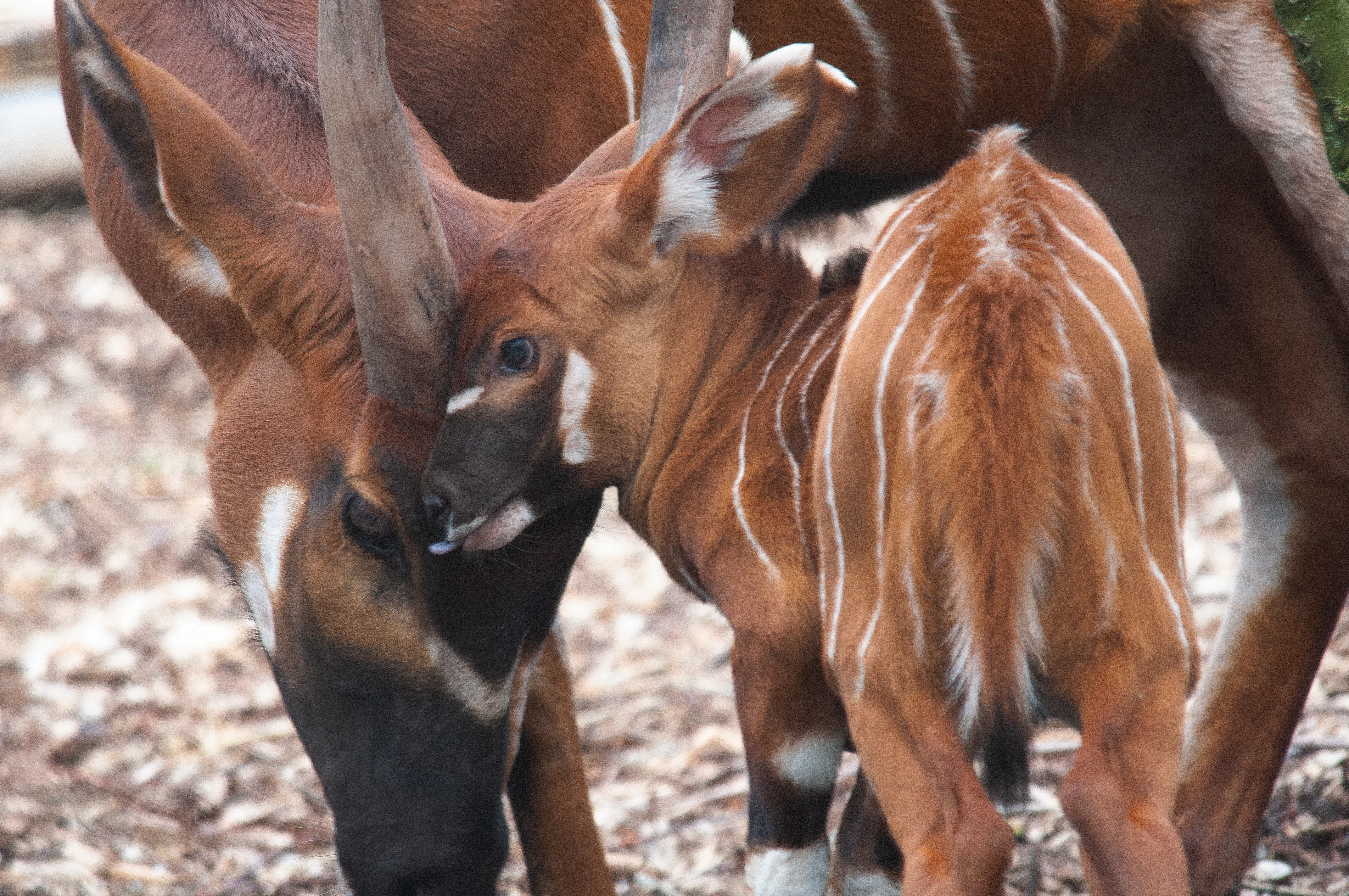
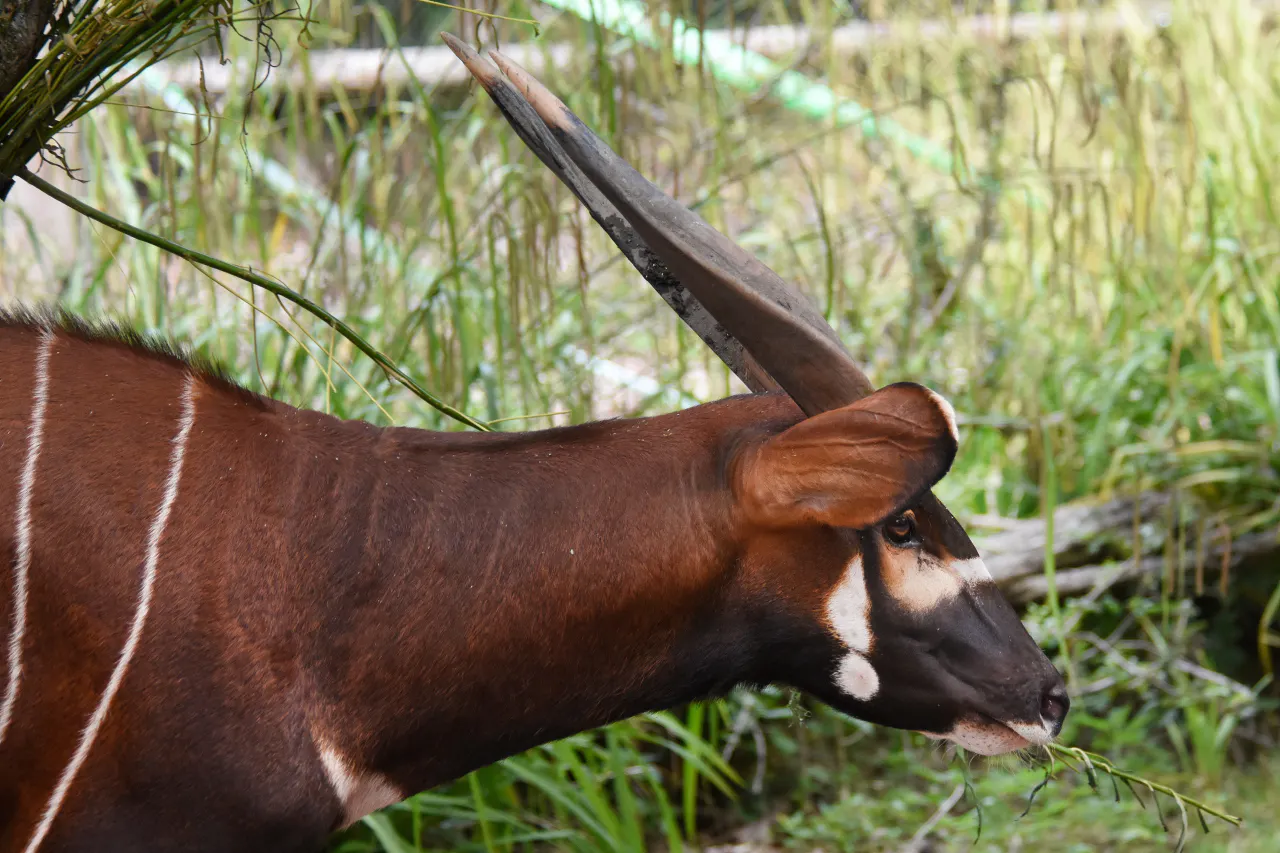
Bongos are large forest antelopes that can be recognised by their reddish-brown coat with white stripes. This coat is black in colour in some areas, particularly on males. The number of stripes can vary between the left and right sides and is usually between ten and fifteen. They have large ears and long, curling horns that can grow up to 1 metre in length.
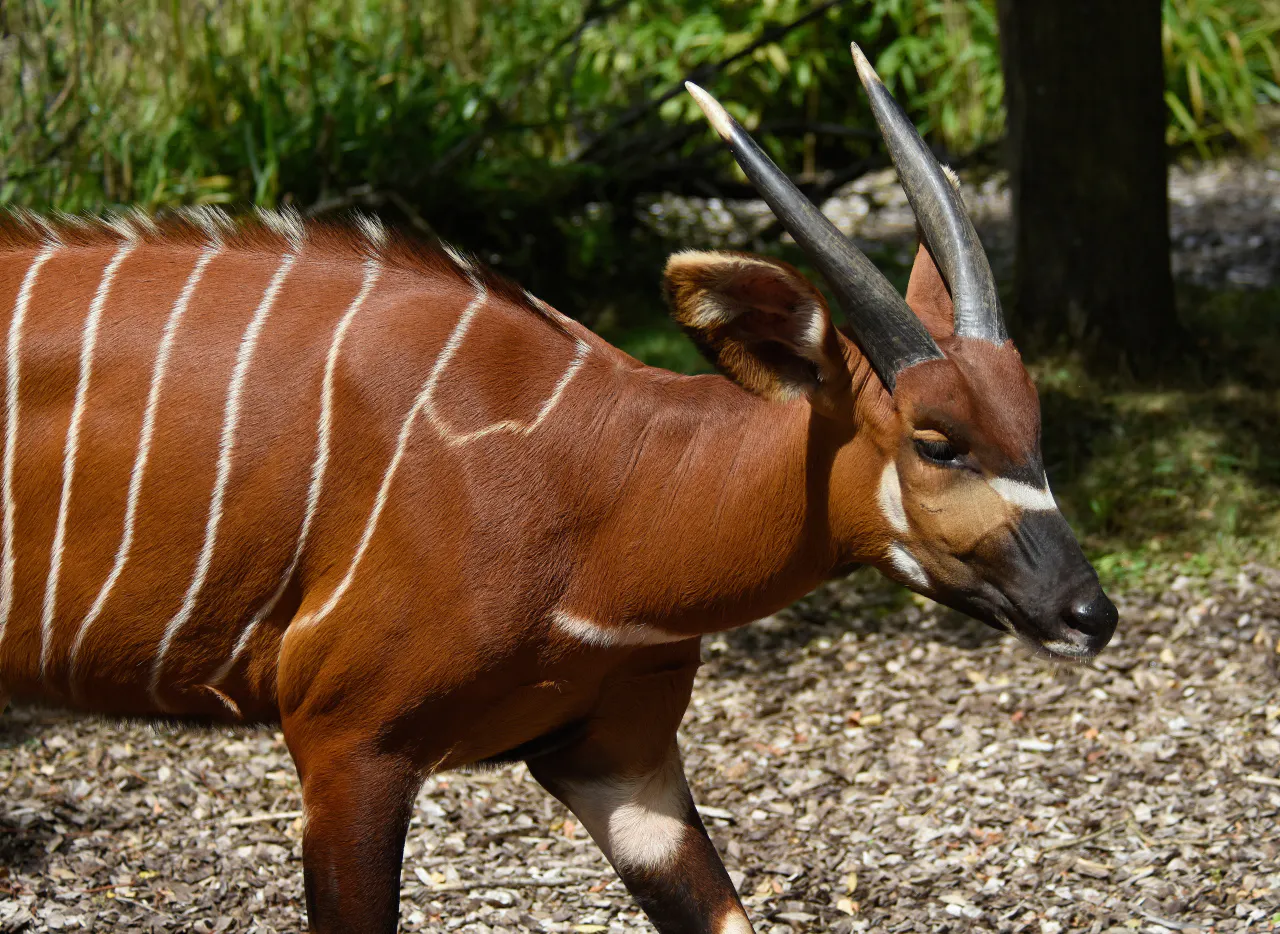
Bongos live in the African rainforest. During the day, they rest and ruminate there in the dense woods. At night, they become active and head to clearings or the forest edge to feed.
There are two subspecies of the bongo, each with different habitats. The Western or lowland bongo is the most common and lives in the lowland rainforests of Central and West Africa. The Eastern or mountain bongo is very rare and is now found only in a few small mountainous areas in Kenya. It is this rare subspecies that can be seen at Rotterdam Zoo.
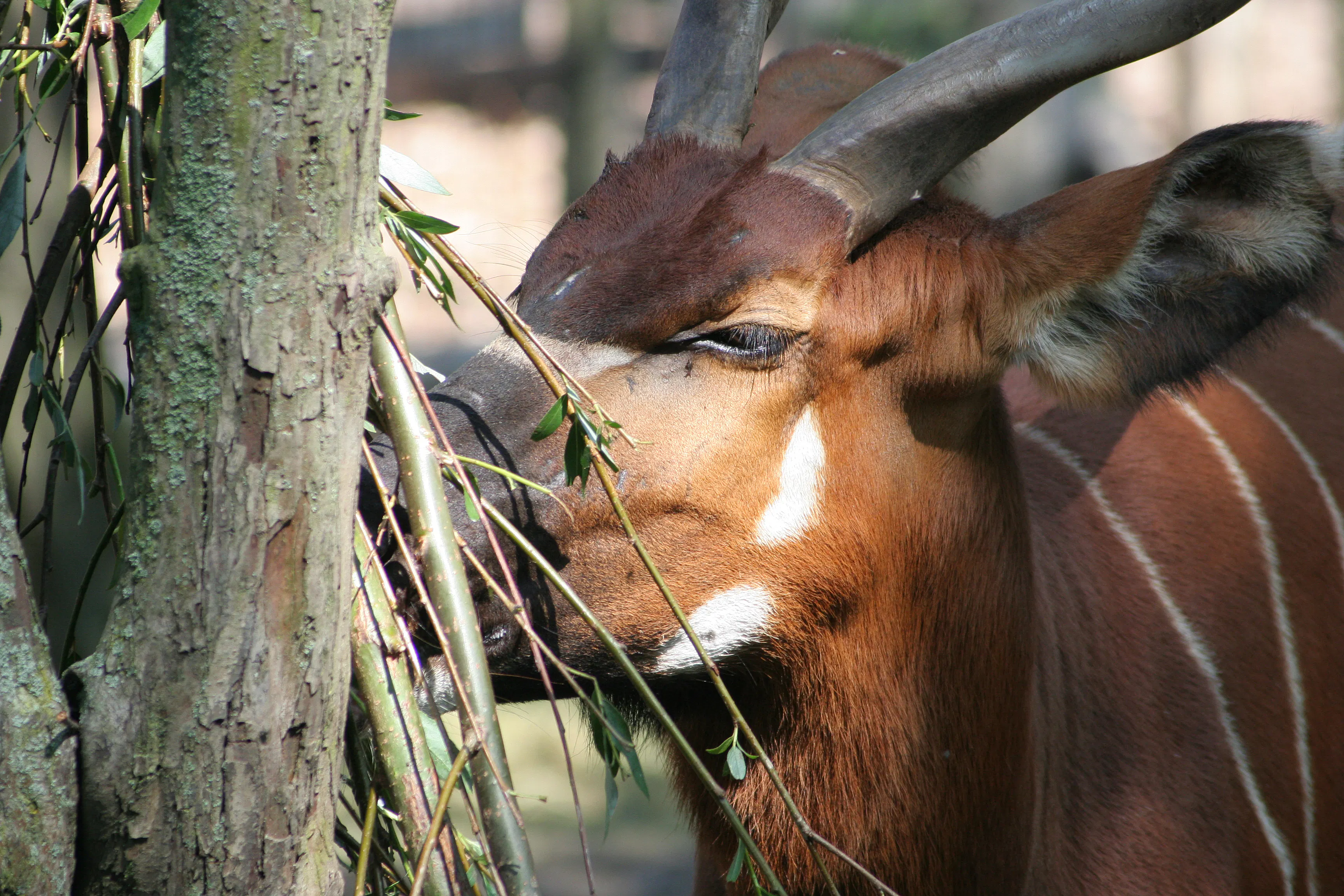
Bongos are herbivores that mainly eat leaves and, to a lesser extent, grass. They use their long tongues to grasp leaves and pull them off branches. When they cannot reach the leaves of a tall shrub or low tree, they use their horns to break off branches.
Just like humans, animals need various minerals to survive, like salt. This is a problem for bongos because the plants they eat contain very few of these substances. For this reason, they go to special clearings where the soil is rich in minerals. There, they drink muddy water or even eat soil directly to ensure they ingest these nutrients.
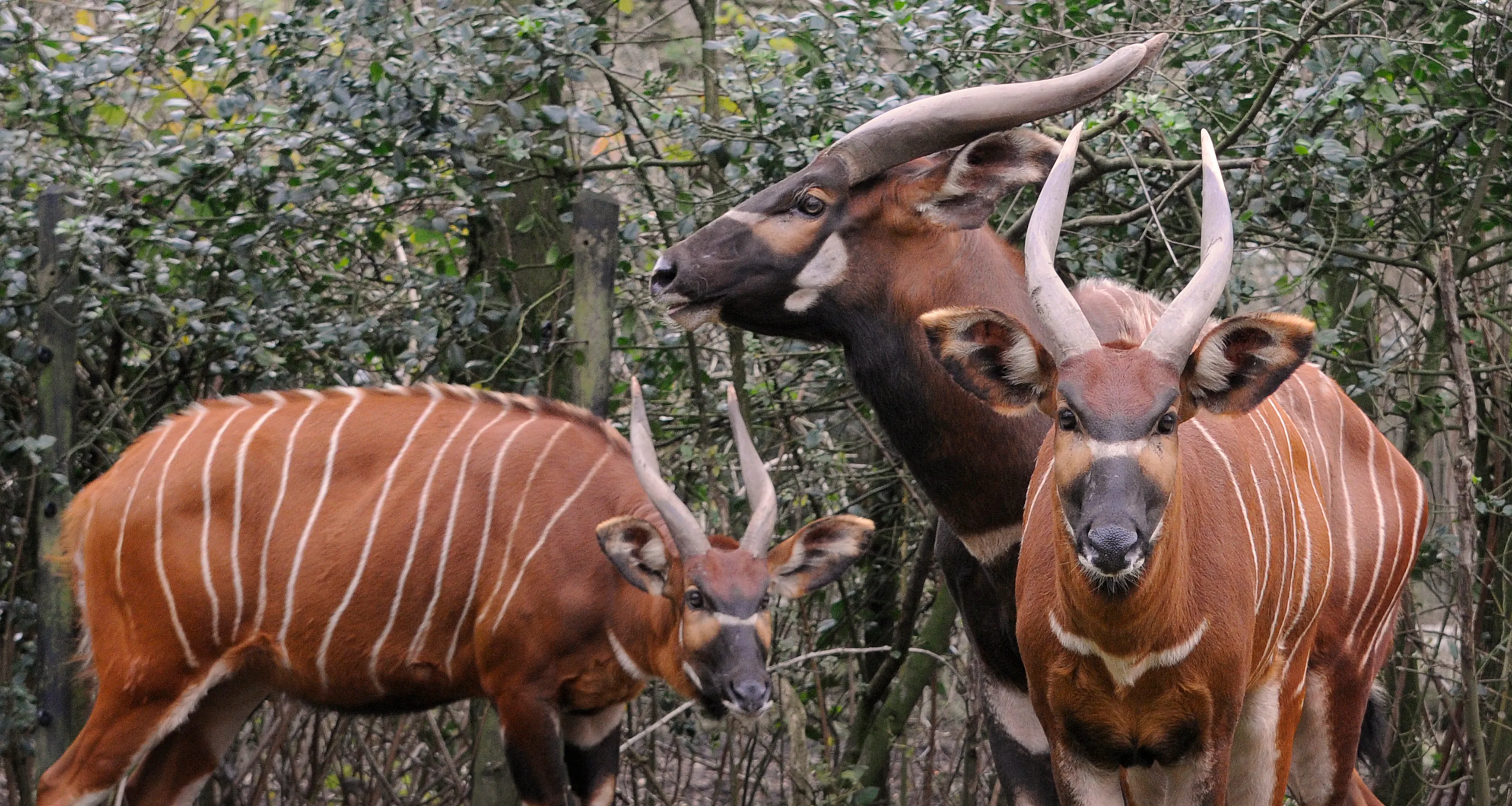
Bongos do both! Females live in small herds with their young. Males leave these herds as soon as they reach adulthood. They then spend most of their time living alone. Occasionally, a young male will join an older male. Apart from that, males only live in groups when they wish to mate.
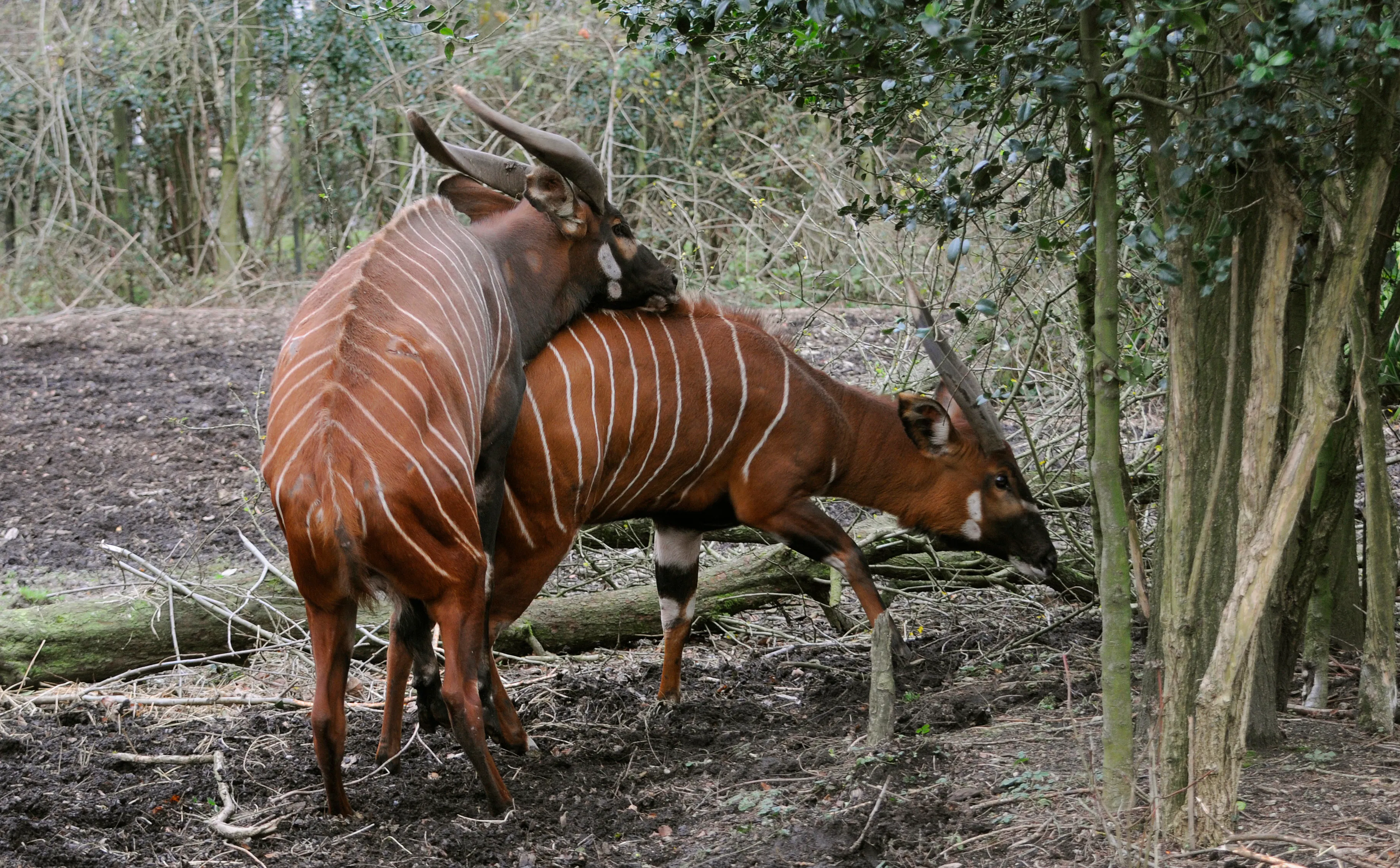
In the dense rainforest, bongos do not often come across one another. As a result, they have little chance of finding a mate. Fortunately, there are places that all bongos have to visit from time to time. In particular, the clearings where they eat salt. Here, a male temporarily joins a herd in order to mate.
When a male has found a female he wishes to mate with, he tries to impress her by presenting his side to her with his head held high. Unlike other antelopes, he does not try to stop the female if she does not wish to mate.

When a female bongo is about to give birth, she temporarily leaves her herd. She then hides her young safely amongst the plants. The young stays there for over a week, whilst the mother drops by from time to time to nurse them. The young grows rapidly during this time. After just over a week, they are ready to join the herd.

Large mammals such as lions, leopards and hyenas are the bongo’s main predators. Bongos are very shy and will run away at the slightest sign of danger. They then run to a sheltered spot and stand with their backs to the danger. They do this because bongos are less conspicuous from behind. It also makes it easier for them to run away if they are spotted. Whilst running, they keep their horns flat against their backs. This prevents them from getting caught in plants.
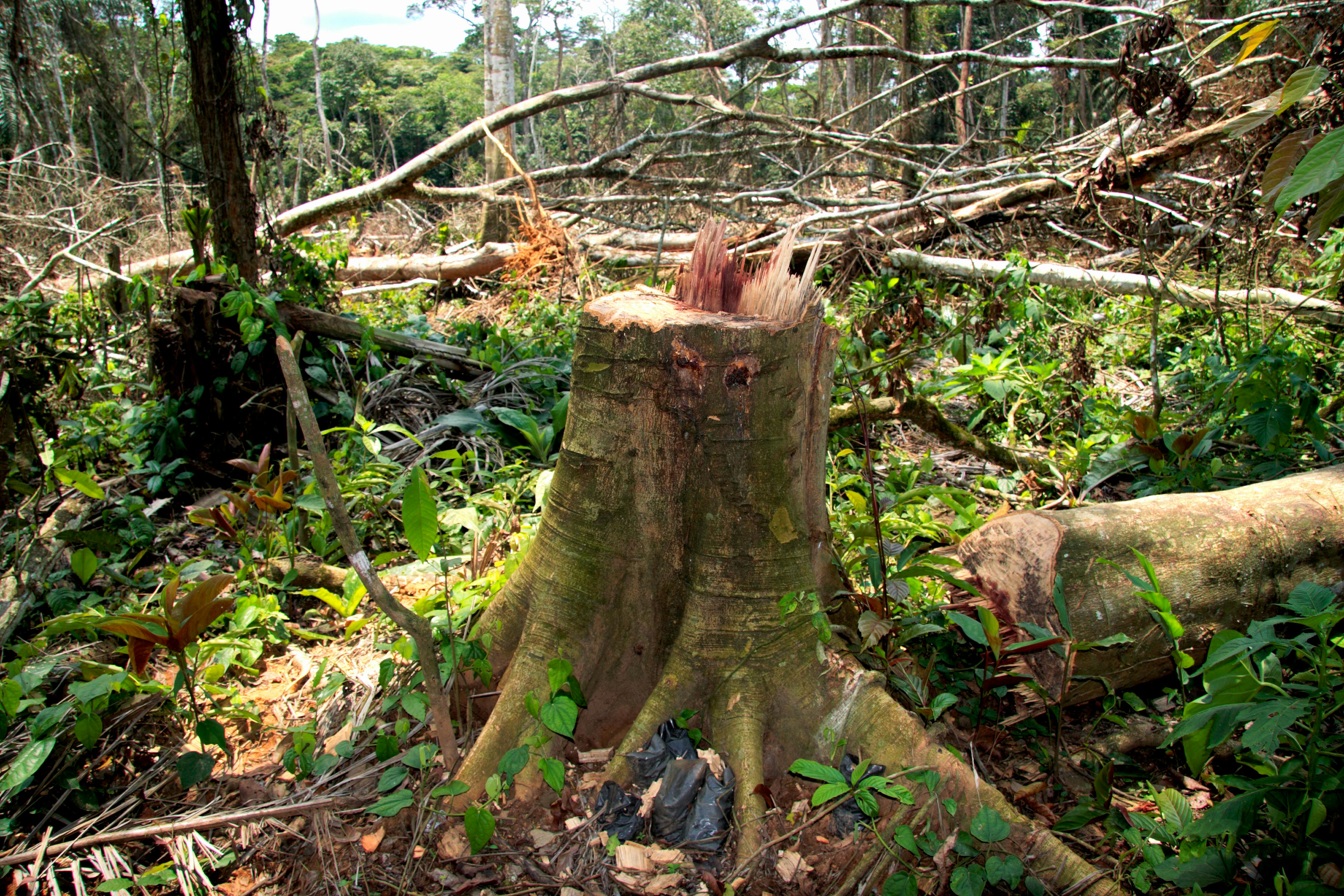
A major threat to the Eastern bongo is diseases transmitted from farm animals. In 1890, an epidemic of rinderpest even nearly wiped out the entire subspecies. People hunting them for food or as trophies, combined with an increase in natural predators, are further reducing their numbers. Their habitat is also shrinking due to illegal logging and the expansion of farms. As a result of all these threats, the Eastern bongo is listed as ‘critically endangered’ on the IUCN Red List.
Fortunately, there is still hope. Bongos thrive in disturbed forests, such as rainforest recovering from deforestation. This allows their habitat to expand again in a short space of time. If the threats cease, the Eastern bongo can therefore recover.
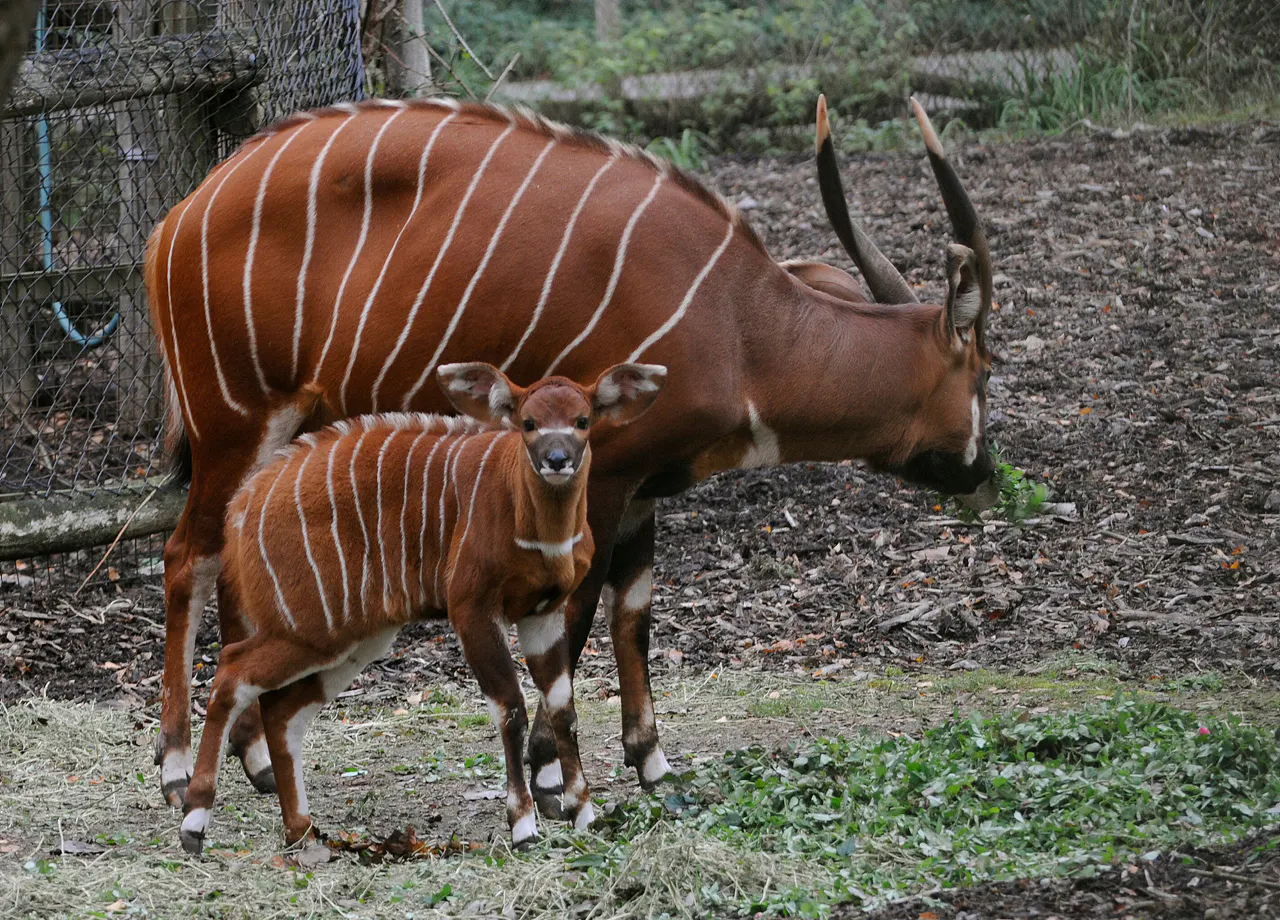
Rotterdam Zoo participates in the European Eastern bongo population management programme. Based on the pedigree of bongos in zoos, the coordinator determines which animals are best paired with each other to produce healthy offspring. These young animals are then transferred to other zoos to form the next generation. In this way, we are building up a healthy population as a back-up for wild animals, with the ultimate goal of returning bongos to their natural habitat when conditions there are favourable.